My work originates from a personal experience that dates back to childhood, when I accompanied my father, a reconstructive plastic surgeon, to Hospital Belén in Trujillo.
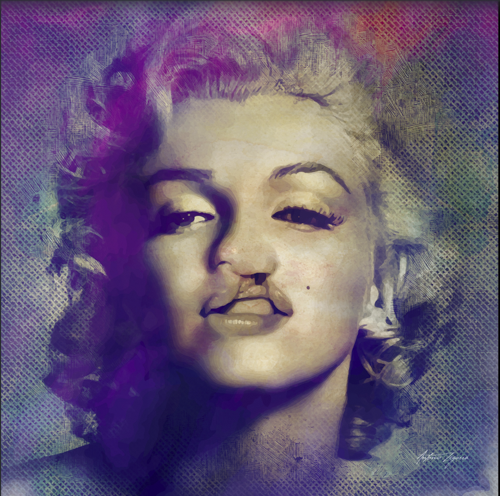
There, I encountered faces marked by burns, accidents, malformations, and processes of reconstruction. That experience shaped my understanding of the human face. I studied medicine, but found in art a way to continue that same impulse, working on the face as a space of transformation, grounded in the idea that everyone has the right to construct an identity. I do not simply depict faces, I intervene, transform, and push them toward a threshold between beauty, deformation, and memory. In many cases, particularly in faces marked by trauma or malformation, I approach them as if they were patients, images undergoing processes of analysis, intervention, or reconstruction, developed digitally with a logic close to painting and with a strong emphasis on detail and precision.
I come from a region of Peru where an ancestral culture developed a particular way of representing human faces in ceramics with a high degree of realism. The portrait vessels of the Moche culture, developed between 100 and 700 AD, depict individuals with cleft lips, signs of aging, diseases, deformities, and even animal traits. It is not entirely clear whether these portraits represented elite figures or also common people, but they reveal an intention to register human diversity without idealization. I am drawn to that perspective and see my work as a continuation of this logic in a contemporary context. Just as the face was once modeled in clay, I now construct it through digital means.
At the same time, I develop projects where art functions as a therapeutic tool, especially with children with cleft lip and palate, establishing a direct link between my personal history and my artistic practice.
My work exists at the intersection of art, medicine, and technology, where the face is no longer just an image, but a field of intervention.